Group migration by direct transfer
To use direct transfer, ensure your GitLab installation is accessible from GitLab IP addresses and has a public DNS entry.
Group migration by direct transfer is the evolution of migrating groups and projects using file exports. The goal is to have an easier way for the user to migrate a whole group, including projects, from one GitLab instance to another.
Design decisions
The following architectural diagram illustrates how the Group Migration works with a set of ETL Pipelines leveraging from the current GitLab APIs.
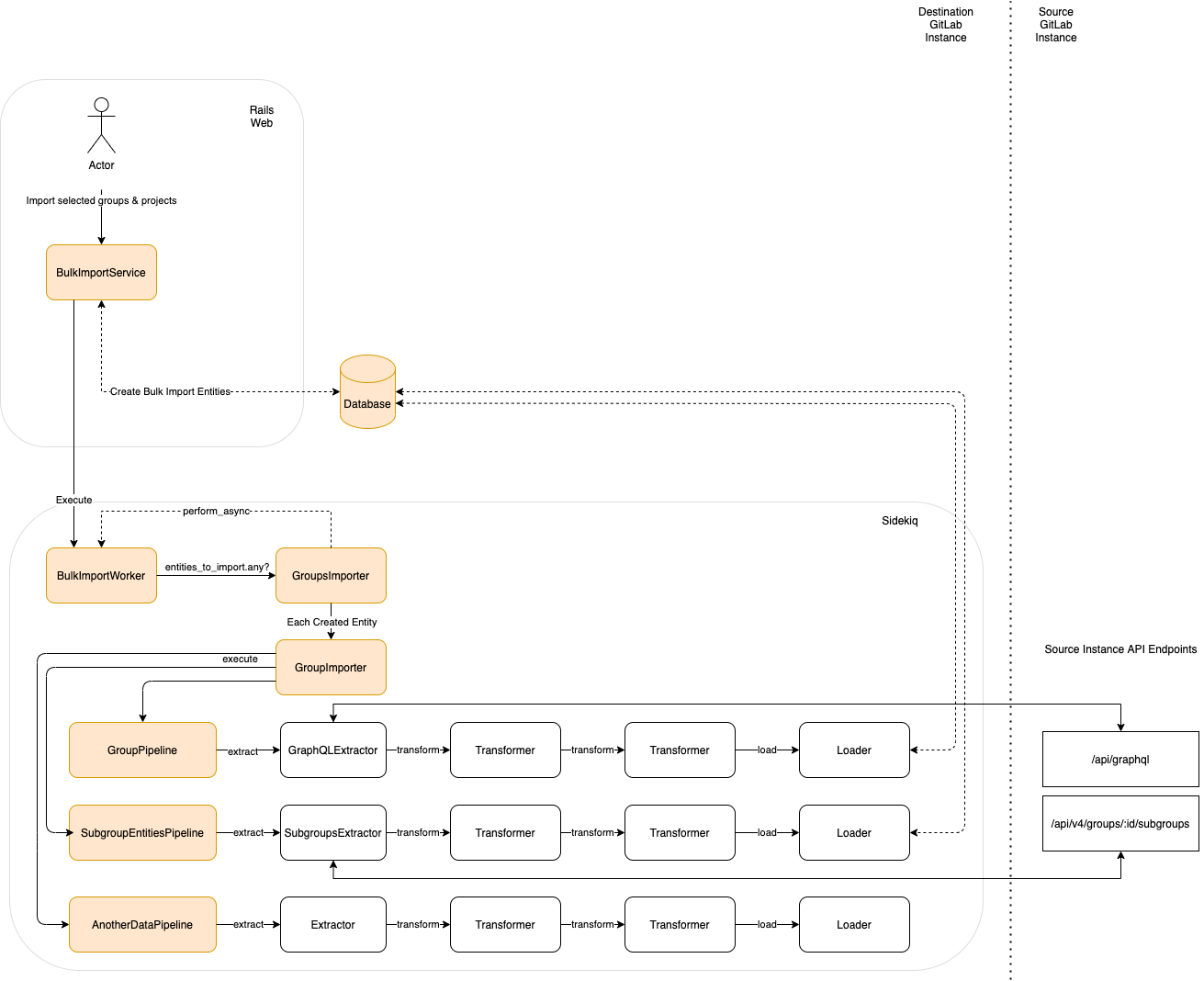
ETL
ETL, for extract, transform and load, is a data integration process that combines data from multiple data sources into a single, consistent data store that is loaded into a data warehouse or other target system.
Using ETL architecture makes the code more explicit and easier to follow, test and extend. The idea is to have one ETL pipeline for each relation to be imported.
API
The current project and group imports are file based, so they require an export step to generate the file to be imported.
Group migration by direct transfer leverages the GitLab API to speed the migration.
And, because we’re on the road to GraphQL, Group migration by direct transfer can contribute to expanding GraphQL API coverage, which benefits both GitLab and its users.
Namespace
The migration process starts with the creation of a BulkImport
record to keep track of the migration. From there all the code related to the
GitLab Group Migration can be found under the new BulkImports namespace in all the application layers.
Idempotency
To ensure we don’t get duplicate entries when re-running the same Sidekiq job, we cache each entry as it’s processed and skip entries if they’re present in the cache.
There are two different strategies:
BulkImports::Pipeline::HexdigestCacheStrategy, which caches a hexdigest representation of the data.BulkImports::Pipeline::IndexCacheStrategy, which caches the last processed index of an entry in a pipeline.
Sidekiq jobs execution hierarchy
On destination instance:
flowchart TD
    subgraph s1["Main"]
        BulkImportWorker -- Enqueue itself --> BulkImportWorker
        BulkImportWorker --> BulkImports::ExportRequestWorker
        BulkImports::ExportRequestWorker --> BulkImports::EntityWorker
        BulkImports::EntityWorker -- Enqueue itself --> BulkImports::EntityWorker
        BulkImports::EntityWorker --> BulkImports::PipelineWorker
        BulkImports::PipelineWorker -- Enqueue itself --> BulkImports::PipelineWorker
        BulkImports::EntityWorker --> BulkImports::PipelineWorkerA["BulkImports::PipelineWorker"]
        BulkImports::EntityWorker --> BulkImports::PipelineWorkerA1["..."]

        BulkImportWorker --> BulkImports::ExportRequestWorkerB["BulkImports::ExportRequestWorker"]
        BulkImports::ExportRequestWorkerB --> BulkImports::PipelineWorkerBB["..."]
    end

    subgraph s2["Batched pipelines"]
        BulkImports::PipelineWorker --> BulkImports::PipelineBatchWorker
        BulkImports::PipelineWorker --> BulkImports::PipelineBatchWorkerA["..."]
        BulkImports::PipelineBatchWorker --> BulkImports::FinishBatchedPipelineWorker
    end
flowchart TD
  subgraph s1["Cron"]
    BulkImports::StaleImportWorker
  end
On source instance:
flowchart TD
    subgraph s1["Main"]
        BulkImports::RelationExportWorker
    end

    subgraph s2["Batched relations"]
        BulkImports::RelationExportWorker --> BulkImports::RelationBatchExportWorker
        BulkImports::RelationExportWorker --> BulkImports::RelationBatchExportWorkerA["..."]
        BulkImports::RelationBatchExportWorker --> BulkImports::FinishBatchedRelationExportWorker
    end
User contribution mapping
Direct transfer supports user contribution mapping, which allows imported records to be attributed to placeholder users until a real user can be assigned after the import completes.
Central components
BulkImports::Common::Pipelines::MembersPipelineis the pipeline responsible for creating most source user and placeholder records because user contributions typically come from group and project members. Its transformer,BulkImports::Common::Transformers::SourceUserMemberAttributesTransformercallsImport::SourceUserMapperto map source members attributes to users on the destination. However, because users don’t have to be members to make contributions, and imported relation data may not include identifying user data like names and usernames, source users may get created by other relation pipelines without them.BulkImports::SourceUsersAttributesWorkerbackfills source user information for non-member contributors. It’s initially called at the beginning of a migration, just beforeBulkImportWorkerinBulkImports::CreateService.BulkImports::SourceUsersAttributesWorkercallsBulkImports::UpdateSourceUsersServicefor each entity’s top-level namespace and continuously re-enqueues itself every 5 minutes until the bulk import is completed.BulkImports::UpdateSourceUsersServicequeries forImport::SourceUserrecords missing asource_nameorsource_usernameassociated with the current migration, then makes a GraphQL to the source instance to fetch the missing names and usernames and finally updates the source users missing information.
Key classes
| Class | Purpose |
|---|---|
BulkImports::Pipeline::Context |
Provides source_user_mapper and source_ghost_user_id to pipelines. |
BulkImports::CreateService |
Entry point that enables user mapping. |
BulkImports::NdjsonPipeline |
Creates Import::SourceUser records before persisting relations using ImportExport::Base::RelationFactory and caches placeholder references during relation import for the relations that require them. |
BulkImports::Common::Pipelines::MembersPipeline |
Responsible for creating most source user and placeholder records as user contributions typically come from group and project members |
BulkImports::Common::Transformers::SourceUserMemberAttributesTransformer |
Calls Import::SourceUserMapper to map source members attributes to users on the destination. However, because users don’t have to be members to make contributions, and imported relation data may not include identifying user data like names and usernames, source users may get created by other relation pipelines without them |
Import::BulkImports::SourceUsersMapper |
Provides a hash-like interface forImportExport::Base::RelationFactory to map source user IDs to destination user IDs, allowing both direct transfer and file-based import to use ImportExport::Base::RelationFactory even though file-based imports do not support placeholder user mapping. |
BulkImports::SourceUsersAttributesWorker |
backfills source user information for non-member contributors. It’s initially called at the beginning of a migration, just beforeBulkImportWorker in BulkImports::CreateService. Calls BulkImports::UpdateSourceUsersServicefor each entity’s top-level namespace and continuously re-enqueues itself every 5 minutes until the bulk import is completed. |
BulkImports::UpdateSourceUsersService |
Queries forImport::SourceUser records missing a source_name or source_username associated with the current migration, then makes a GraphQL to the source instance to fetch the missing names and usernames and finally updates the source users missing information. |
Ghost user handling
Direct transfer has special handling for the source instance’s ghost user. The BulkImports::SourceInternalUserFinder makes a GraphQL request to the source instance to query for non-human users with GitLab ghost usernames (at the time of implementation, there was no explicit API request for ghost users) and caches the source ghost user ID.
When a source ghost user is encountered:
- Contributions are assigned directly to the destination instance’s ghost user
- No placeholder user is created
Skipped placeholder user creation
Certain relations (e.g. approvals, builds, ci_pipelines, events) skip placeholder user creation because they may reference users that no longer exist on the source instance (lacking foreign key constraints). See BulkImports::NdjsonPipeline::IGNORE_PLACEHOLDER_USER_CREATION